Eight Arms, No Center: The Distributed Mind of the Octopus and What It Reveals About Consciousness
Most scientific discussions of consciousness begin with an implicit assumption so foundational it rarely surfaces for examination: that awareness is a product of centralized neural integration. The brain — or at minimum, a sufficiently dense and interconnected hub of neural tissue — processes information, binds it into unified experience, and generates something we recognize as a mind. This picture is so thoroughly embedded in neuroscience that challenging it feels almost categorical rather than empirical.
The octopus does not appear to have received this memo.
A Nervous System That Defies Centralization
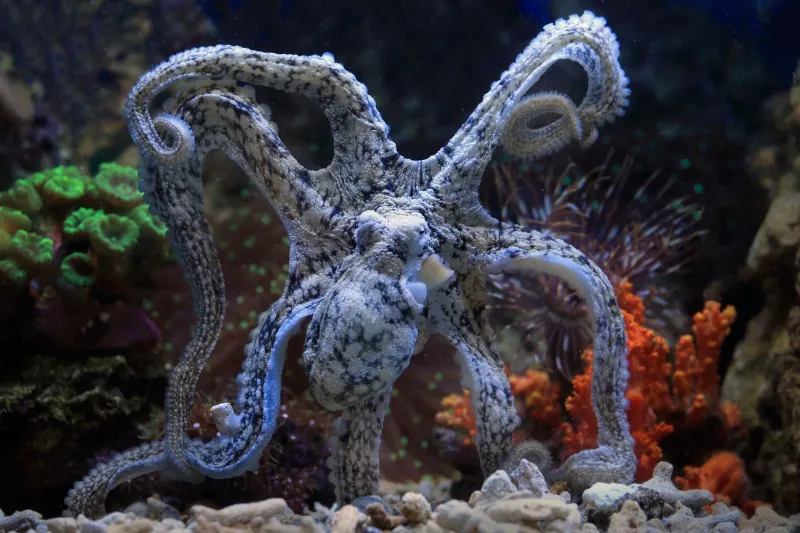
Cephalopod neurobiology presents a structural anomaly that has fascinated researchers for decades and taken on renewed theoretical significance in light of recent behavioral work. Of the approximately 500 million neurons in a common octopus (Octopus vulgaris), roughly 300 million — nearly two-thirds — reside not in the central brain but in the eight arms themselves, distributed across a series of brachial ganglia that run the length of each limb.
These are not relay stations that forward commands from a central processor. They are, by any functional definition, local decision-making systems. When an octopus arm encounters an obstacle or an object of interest, the arm's own neural circuitry evaluates the situation and generates an appropriate motor response. The central brain may issue a high-level directive — reach toward that crab — but the precise execution, the moment-to-moment coordination of hundreds of suckers and muscle groups, is handled locally, below the threshold of central awareness.
Severed octopus arms, in laboratory settings, continue to respond to stimuli for up to an hour post-separation. They reach, retract, and attempt to pass food toward a mouth that is no longer there. Whatever drives that behavior is encoded in the arm itself.
Problem-Solving at the Periphery
Behavioral research conducted over the past decade has substantially deepened the picture of octopus cognition. Studies at institutions including the Woods Hole Marine Biological Laboratory and the University of Naples have documented problem-solving abilities — jar-opening, maze navigation, tool use with coconut shell halves — that would be unremarkable if observed in a primate but become theoretically significant given the architectural context in which they occur.
The question is not whether octopuses are intelligent. That much is settled. The question is where, structurally, that intelligence lives.
Recent work on octopus sleep has added a particularly evocative data point. In 2021, researchers at the Okinawa Institute of Science and Technology published observations of octopuses cycling through what appeared to be an active sleep state — rapid chromatophore flickering, arm twitching, and eye movement — reminiscent of mammalian REM sleep. The authors speculated, cautiously, that the animals might be experiencing something functionally analogous to dreaming. The speculation is difficult to evaluate empirically, but the observation itself is striking: a nervous system organized so differently from the vertebrate brain appears to generate the same kind of dynamic internal state.
What makes this relevant to consciousness research is that REM sleep in mammals is associated with the consolidation of memory, the processing of experience, and — in the context of consciousness science — some of the most robust correlates of subjective awareness. If an octopus cycles through an analogous state, the question of whether that state involves any form of experience becomes genuinely difficult to dismiss.
Challenging the Integration Requirement
Dominant theories of consciousness in the neuroscientific literature tend to emphasize integration. Global Workspace Theory, associated with Bernard Baars and elaborated computationally by Stanislas Dehaene, holds that consciousness arises when information is broadcast widely across a unified neural workspace, making it available to multiple cognitive systems simultaneously. Integrated Information Theory, developed by Giulio Tononi, goes further, proposing that consciousness is identical to a specific kind of integrated information — measured by the metric phi — that requires the system to be more than the sum of its parts.
Both frameworks face a problem with the octopus. A nervous system in which large portions operate semi-independently, without continuous integration into a central workspace, should — by these accounts — produce either no consciousness or a dramatically fragmented one. Yet the animal's behavior does not obviously reflect fragmentation. It navigates complex environments, recognizes individual human caretakers, and modulates its behavior based on prior experience in ways that suggest a coherent, if alien, form of agency.
One possible resolution is that the octopus is not conscious in any meaningful sense — that its sophisticated behaviors are the output of a biological automaton whose distributed architecture produces intelligence without experience. This is a defensible position. It is also, given the behavioral data, an increasingly uncomfortable one.
What Distributed Cognition Implies
An alternative interpretation, gaining traction among a minority of consciousness researchers, is that the octopus represents a genuine case of distributed consciousness — awareness that is not localized in a central processor but spread across a network of semi-autonomous nodes. This view aligns with certain readings of panpsychist philosophy and with some versions of embodied cognition theory, which holds that mind is not confined to the brain but extended into the body and its interactions with the environment.
If distributed consciousness is possible — if awareness does not require a unified neural hub but can emerge from the coordinated activity of a decentralized network — the implications extend well beyond cephalopod biology. They touch directly on debates in artificial intelligence about whether consciousness could arise in distributed computational systems, on questions in philosophy of mind about the necessary conditions for subjective experience, and on the still-unresolved hard problem of why any physical system, centralized or otherwise, should give rise to something it is like to be.
The octopus does not resolve these questions. It sharpens them. It presents a natural experiment — an evolutionary path that arrived at sophisticated cognition through a radically different structural solution — and asks whether our theories of mind are genuinely general or merely theories of the vertebrate brain.
The Alien as Mirror
There is a reason cephalopod cognition has attracted interest beyond biology departments. The octopus is often described, with only slight hyperbole, as the closest thing to an alien intelligence that exists on Earth. Its last common ancestor with vertebrates lived more than 500 million years ago. Its nervous system evolved independently, under different constraints, toward a different architecture. If it experiences anything at all, the character of that experience — what it is like, if anything, to be eight semi-autonomous arms loosely coordinated by a small central brain — may be genuinely unlike anything we can model from the inside.
That is precisely why it matters. Science advances not only by confirming what it expects but by taking seriously the cases that do not fit. The octopus is one of those cases. Its distributed neural architecture is not an anomaly to be filed away. It is a challenge to the operating assumptions of consciousness science — one that deserves the kind of rigorous, evidence-based scrutiny that frontier questions demand.